
Did you know that until New Year’s Day on 1903, it took a week for news to travel between Hawaii and the US mainland? Today we can instantly read and hear news with mobile phone, the Internet, and television. At the turn of the 20th century, news traveled by steamship. Can you imagine that?
The idea of a quicker communication method between Hawaii and the US mainland was enthusiastically welcomed. An archived article from the New York Times reported that, “[T]he cable was hauled up on the soil of picturesque San Souci Park amid the shouts of thousands and the crash of a band of music playing a cable march dedicated to President Mackay.” (Note Mackay was the president of the company hired to lay the cable.)
The Commercial Pacific Cable Company laid cable in the ocean that spanned more than 2000 miles from San Francisco to Honolulu. On January 1, 1903 at approximately 8:40pm Hawaii time, the first telegraphed message flashed from San Francisco to Honolulu.
I wasn’t able to find details on the message transmission time between Hawaii and the US mainland. I’d imagine it took a couple of minutes. I base my estimate on this information from Wikipedia:
Later that year, cables were laid from Honolulu to Midway, then from Midway to Guam, and then from Guam to Manila. The cables carried the first message to ever travel around the globe from U.S. President Theodore Roosevelt on July 4, 1903. He wished “a happy Independence Day to the U.S., its territories and properties . . .” It took nine minutes for the message to travel worldwide.
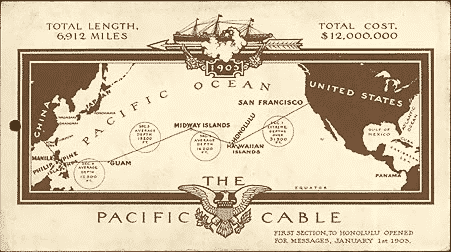
Though we don’t know how long it took that first message to transmit, we do know that communication time was drastically reduced from a week to minutes.
——-
For some additional information on this historic moment, I found this article to be very interesting. Note that some of the dates seem to be off by a couple of weeks.


 Sheila Beal

6 comments
That’s a pretty cool fact! And to think, just a few years ago we complained about the speed of dial-up!
Nice find, the techie in me thinks these numbers are pretty neat.
Amazing what $12 million could do back then.
@ Andy – I can’t imagine going back to dial-up again. That was so sloooooow. We’re spoiled, aren’t we.
@ Kris – I had fun researching this fact. After reading your comment, I started wondering what today’s equivalent of 1903’s $12million would be. Here’s the result: $302,888,159.44 That’s a lot of money!
Electrical Signals travel on copper wires at 2/3 the speed of light. So the time from contact in Hawaii to the mainland was probably only a couple of seconds. The delay was getting the message relayed from one telegrapher to others.
It’s not so much a matter of the speed of light in a cable, it’s a question of the signalling rate. I knew the rate on the Hawaii cable but don’t quite remember but think it was on the order of 10 wpm. It wasn’t that the operators were inept, simply the bandwidth of the cable. In order to send signals at high speed there must be bandwidth to preserve the on-off transitions in recognizable form at the far end at the speed you are trying to send them. Those transitions can be be “smeared” if you make the transitions too fast. In 1858, Queen Victoria’s message to President James Buchanan took approximately 16.5 to 17.5 hours to transmit. Cable operators didn’t listen for clicks or dots, they looked at a galvanometer for transitions equivalent to dashes and dots. When the British tried to speed up the signalling by raising the signal voltage (i.e., raising the “signal to noise ratio” they burned out the cable. Their electrician was a British doctor Dr. Edward Orange Wildman Whitehouse (often referred to simply as Wildman Whitehouse). A high school graduate named Oliver Heaviside and others pointed out his error on the next iteration of the cable, which lasted.
Mackay was not “hired” to lay the Pacific cable; he paid for it to be laid. His father John made a fortune in the Comstock silver mines and dabbled in telegraph and Clarence went on to found Federal Telegraph, intending to put Western Union out of business. Along the way he built commercial radio stations, including the one at Heeia in 1912, which began radio service between Hawaii and California. That station opened two years before the Marconi station at Kahuku and used much better technology.