
As I wrote about our experience kayaking Kauai’s Wailua River, I mentioned how amazed I was at thickets of hau trees at the river’s edge. In case you aren’t familiar with these fascinating trees, I thought I’d introduce them to you.
Experts believe hau trees are either native indigenous to Hawaii or they were brought to Hawaii by Polynesians. According to the Hawaii Division of Land and Natural Resources, “Early Hawaiians used the wood of this species to build the outriggers of canoes, floats for fish nets, long spears for games, and for the cross sticks of kites. The fibrous inner bark of the Hau was also used to create ropes, matts, and bark cloth.”
Hau trees part of the Malvaceae family, that includes hibiscus, cacao, okra, and cotton. Their scientific name is Hibiscus tilaceus. Though a type of hibiscus, hau trees grow much larger and sturdier than a standard hibiscus plant. They can reach heights of around thirty feet.
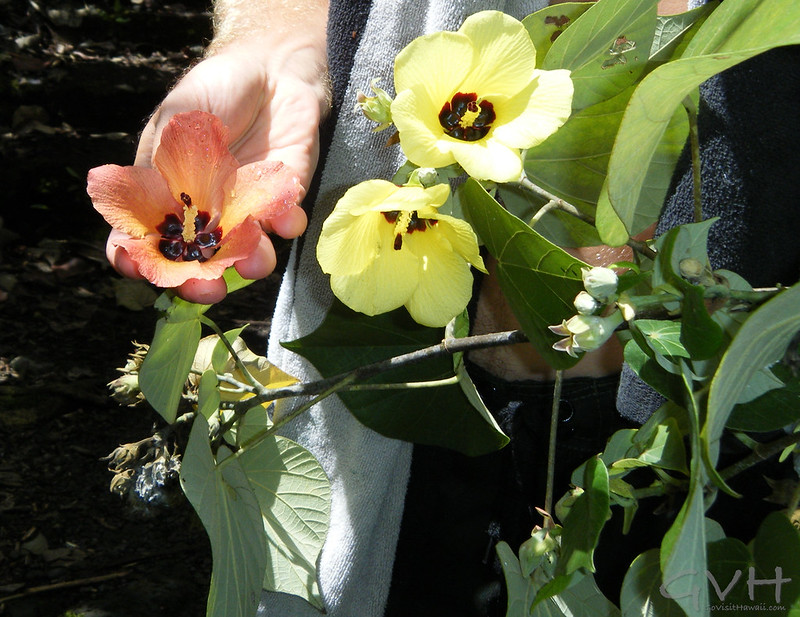
The hau trees that we saw along the Wailua had yellow blooms. If you look closely at the photo below, you might see a few dots of yellow blooms.

What interests me the most about hau trees is how the limbs of the tree twist, tangle and tightly intertwine in the most unexpected ways. Together, they create an impenetrable thicket.

As you might be able to tell from the above photo, the bark is very bumpy with an unusual texture. Each tree is practically a sculptural masterpiece.
When you visit Hawaii, keep an eye open for hau trees by lowland streams and shorelines. You can find them in moist areas in elevations up to 2,000 feet.
Have you noticed hau trees in Hawaii?


 Sheila Beal




3 comments
There is a cultivar of the hau tree, widely planted as an ornamental in Hawaii, with large white and red splotches on the leaves. Where did this striking cultivar originate and is it widely planted elsewhere.
Can I get seeds for the Hau Tree sent to me?
There are some restrictions on moving seeds, plants, trees, fruits, vegetables, etc. from Hawaii to the the U.S. mainland. You could maybe do some google searches to see if there are approved sources for Hau tree seeds.